
Is the App Dead?
Is the app dead? No it’s not but it has moved on.
It's a question that is deliberately provocative but the role of the app is changing. What once was the centre of the customer journey is now becoming part of a much wider ecosystem. As contributing factors such as AI reshape how people discover, interact and buy from digital products, it is becoming harder to ignore.
At Appsforum London 2026, Peggy Ann Salz, Content Strategist and Founder of MobileGroove, Veronica Lee, Global Cross-channel Paid Media - MarTech at H&M, Lisa Kennelly, Global Product Marketing Strategist at Klarna, Lucrezia Leon, CBDO at SpinX and Güner Bayram, Founder at Moovbuddy took to the stage to discuss the question of: if users no longer need to open an app to get value from it, then what does the app become?
AI is changing the playbook
Typically the usual playbook is as follows: we acquire the user, we get them to the app, we understand what we want, we get them back. Where does AI change the playbook the most today?
The panel discussed how AI is becoming a discovery channel with customers increasingly able to ask AI what products, services or apps they should use. H&M, for example, sees AI as a potential new acquisition a
‘’I think we will see AI as one of the discovery channels just like other pay acquisition channels, SEO or even a website or even physical store that they bring customers in.’’ stated

Veronica Lee. ‘’For the H&M app, we have a lot of loyal customers and we want to use AI as a channel to bring the customer instead of thinking of it as an inroad. So it's not a destination on its own exactly. It's about bringing them in.’’
With Klarna, the journey doesn’t start with the app. Lisa Kennelly explains that the company is using AI to bridge the gap between where consumers first encounter Klarna, often through an online purchase, and the point at which they download the app.
AI allows Klarna to draw on thousands of insights from its customer data to understand why people find the app valuable, then test which of those messages resonates most with different audiences. While the team’s expertise and insights still play an important role, this data-driven approach makes the journey from A to B far more personalised, relevant and effective.
Personalisation is key
The panel repeatedly returned to AI’s ability to make experiences more individualised. Rather than segmenting users into broad groups, AI can allow companies to adapt onboarding messaging, recommendations and journeys to individual users.
For Moovbuddy, retention is particularly important because users only experience the full value of the app once they progress through the first four weeks. That makes onboarding a critical part of the retention strategy, and AI is helping the company make that experience more personalised from the outset.
As Güner Bayram highlights: “We couldn’t personalise on this level before AI. It brings a huge advancement for personalisation for every individual user.”
This personalisation starts with the creative. The way users are educated and guided through the app can be tailored based on the creative they first encounter, with the funnel then customised to match. In other words, the first step is personalised creative, followed by a personalised funnel designed to keep users engaged.
Trust matters
As AI takes on a greater role in discovery and decision-making, trust in the brand remains just as important.
The panel pointed to luxury brands as an example. Some have no app at all, yet their reputation is strong enough that customers will still seek them out through their websites and continue to buy their products.
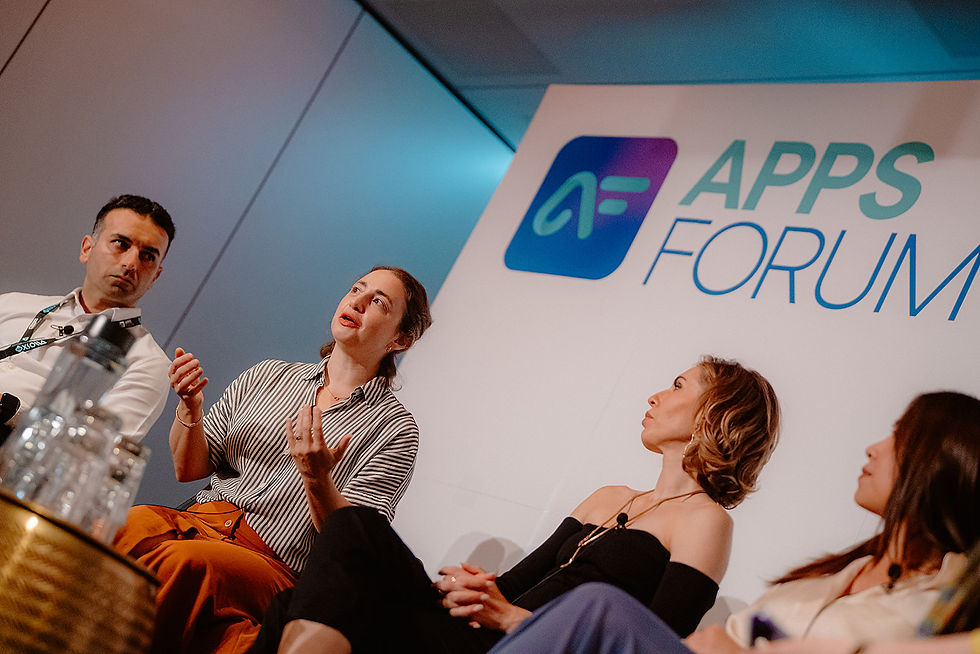
Lucrezia Leon from SpinX stated: “When it comes to trust and reliability, it gets the user to make a decision to continue to use the app.”
That trust could become even more important as AI increasingly acts on the customer's behalf. Rather than simply helping users search, AI is beginning to influence which products, services and apps they discover in the first place. In this sense, AI is becoming another customer that brands need to consider.
That is already changing how companies think about their digital presence. H&M, for example, is approaching AI in a similar way to SEO and ASO, optimising its content so that it is “machine readable” and ensuring the information AI finds is “trustworthy, accessible and also accurate enough” to present to users.
But AI won't necessarily replace the role of the app itself. One of the panel's key distinctions was between discovery and structure. Consumers may increasingly trust AI to search, find and compare things for them, but apps still provide the structured experience that allows users to actually complete a task.
As Lisa Kennelly explained: “Most people are kind of trusting AI to search and go find things for them... But I think what people are using AI for less is, like, structure this for me. And that's what apps still do.”
This leaves brands with an increasingly complex balancing act: make their content accessible and useful to AI, while maintaining control over the experience once a customer arrives.
AI can also be used to strengthen that relationship. Moovbuddy, for example, has introduced AI-powered customer support workflows that can handle tickets, refunds and cancellations without human intervention. The company said this has resulted in increased trust and more positive feedback from users.
Güner Bayram explained: “Building trust is earned and it's long term and you can use AI to build trust.”
The takeaway is that AI doesn't necessarily have to weaken the relationship between brands and customers. Used well, it can remove friction while reinforcing the reliability and responsiveness that creates trust in the first place.
The risk of everything becoming the same
There is also a danger in giving AI too much control over the creative process. Klarna's Lisa Kennelly made the point that AI can easily produce the basic tactics, but that isn't necessarily where competitive advantage lies: “That is what's generic, but that's not where

you can compete.”
She argued that the real differentiator remains the thinking behind those tactics: “It was like the strategy and the inputs. That's the hard part and that's the unique part.”
That is particularly important as more companies use the same AI tools to generate onboarding flows, messaging and creativity. If everyone is working from the same technology, there is a risk that experiences begin to look and feel increasingly similar.
The panel also stressed that humans still need to provide the judgement behind AI. As Kennelly put it: “We're the ones ultimately... steering the AI.”
AI can make it faster to produce an experience, but that doesn't necessarily make the experience better. Human testing and customer understanding remain critical, particularly when it comes to judging whether something actually works.
The competitive advantage, then, may come less from who has access to the best AI tools and more from who gives those tools the best inputs: better customer insight, stronger strategy and a clearer understanding of what users actually need.
So, is the app dead?
Not quite.
What is changing is the role the app plays in the journey. If AI removes steps between discovery, consideration and action, users may increasingly get value from a service without following the traditional path of finding, downloading and opening an app.
That doesn’t make the app irrelevant. It makes the app just one part of a much bigger experience.
And perhaps the most revealing answer came at the end of the panel, when speakers were asked whether they would rather be an app people choose to open, a service AI chooses to use, or a brand AI recommends. H&M's Veronica Lee chose the latter:
“If the LLM, which is represented by the AI, recommends us, then that is the gold standard.”
The question for app businesses is therefore no longer simply how to get people to open their app. It is how to build something that is useful enough for people to choose, trustworthy enough for AI to recommend, and distinctive enough to remain meaningful when AI makes comparison easier.
The app isn't dead. But the era of the app as the centre of the customer journey may be coming to an end.



Comments